
Your Cart
Disposable Cake Holders: The Base Decides Whether the Cake Arrives Level
When a cake arrives damaged, the investigation usually starts at the lid — did it pop, did it fog, did it scratch. More often the failure started underneath. The cake shifted a few millimetres on a flexing base, the board rocked inside a rim that never gripped it, or the bottom of a stacked tower deformed just enough to tilt everything above it. A disposable cake holder is the least glamorous component in bakery packaging, and it is the one that decides whether the cake is level when the customer opens the bag. This guide covers why bases fail first, how to fit the board–base–box system properly, which format suits which product, and what bulk buying looks like when you get it right.

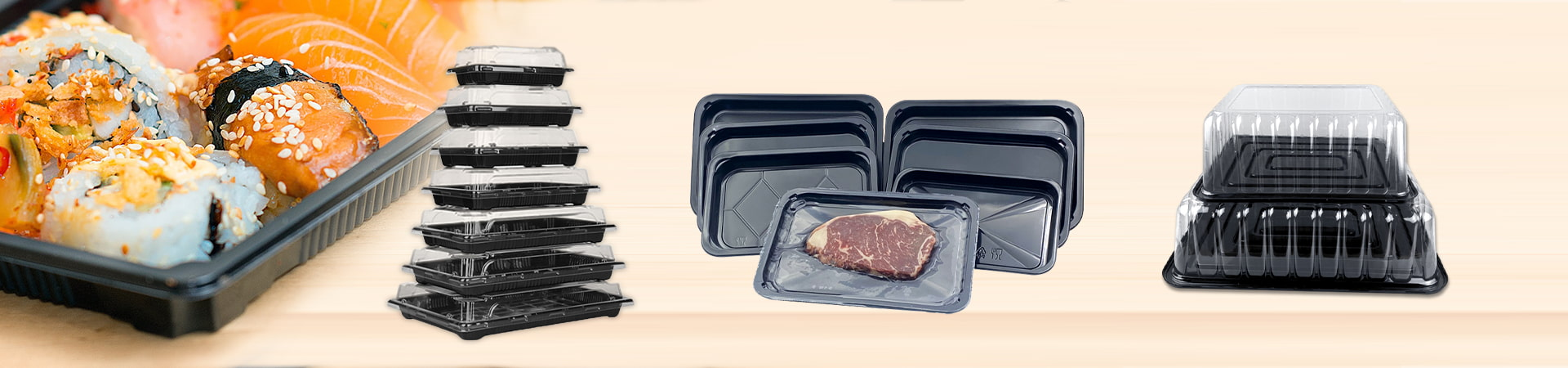
Deep bases, dome lids and flat trays — each format answers a different transport problem.
Why the Base Fails First
A cake is a soft, heavy load concentrated on one point. Under stacking pressure, a thin base does not crack — it creeps: the centre sags over hours, the walls bow outward, and the cake inside tilts without anything visibly breaking. Add a delivery van’s vibration and the cake slides on its board in small oscillations, planing off frosting one pass at a time. By the time anyone lifts the lid, the damage reads as “bad handling,” but the physics say otherwise.
This is why base specification deserves the same scrutiny as lid design: material thickness at the centre, ribbing under the load area, and a rim that actually captures the cake board. A top-selling disposable cake holder earns that ranking by holding a loaded board still through tilt and stack — which is exactly the test most buyers never run before committing to a pallet.
Fit Logic: Board, Base and Box as One System
Three components must agree, and each pair has its own failure mode. Check them as a chain before the first bulk order:
| Pair | What must match | Failure if it doesn’t |
|---|---|---|
| Board → holder rim | Board diameter seats inside the rim without rocking | Cake pivots on the board edge; frosting shears |
| Holder → box | Base outer diameter fits the box inner wall | Lid cannot seat; snap rail never engages |
| Box → finished cake | Clearance over the tallest topper | Decoration presses into the lid on the first bump |
The classic bakery example is the 8-inch cake. It travels on a 10-inch board (bakers prefer the larger board for handling), so the holder must accept a 10-inch board, and the box must accept the holder — which is how a 8-inch cake ends up needing a 12-inch outer box. Sizing any single component in isolation is how mismatched pallets happen. A dedicated fashion round cake container for 8-inch cakes takes that arithmetic off your counter staff, because board, clearance and lid height are pre-matched to the product.

A pre-matched 8-inch format: scalloped wall clearance sized for decoration, no on-the-fly measuring.
Four Formats and Where Each Wins
“Cake holder” covers several distinct products, and picking the wrong family is a common bulk-order regret:
| Format | Best for | Strengths | Watch for |
|---|---|---|---|
| Deep base + dome lid | Whole celebration cakes | Height for decoration; 360° display | PET dome is not microwave-safe |
| Ribbed straight-wall round | Everyday round cakes | Ribs add stack strength; uniform towers | Wall ribs reduce inner clearance slightly |
| Scalloped / fashion edge | Premium and seasonal lines | Shelf appeal without custom tooling | Confirm same snap rail as workhorse line |
| Half-moon slice packs | Café slices, cut cakes | Single-serve; fits chiller corners | Portion width varies by cake style |
Most bakeries need two of these four, not all of them: one workhorse format for volume and one presentation format for premium SKUs. A fashion round cake container line covers the second role, and sharing lids or base diameters across the two keeps the storeroom simple.
Black Bases Sell the Cake
Base colour is a display decision, not a default. A black holder under a bright sponge or a chocolate ganache creates contrast, so the cake edge reads sharply through the clear wall — the same reason patisseries plate on dark slate. White and clear bases disappear into the cake and suit pale-toned products; black frames nearly everything else. Whatever the colour, the wall stiffness and rim capture matter more than the tint, so decide colour second and fit first.
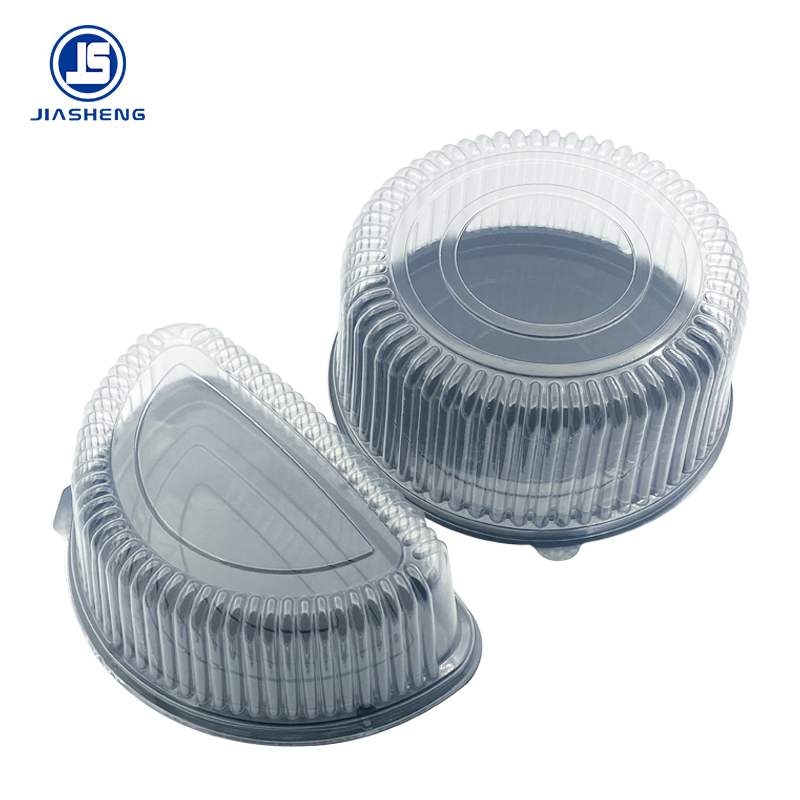
Round workhorse and half-moon slice pack share the same ribbed-wall logic.
Bulk Buying: Packs, Nesting and Stock Discipline
Holders and boxes are voluminous, and storeroom reality shapes which SKU is practical. Two features do most of the work:
- Nesting when empty. Thermoformed bases stack inside each other, so a pallet of holders occupies a fraction of its assembled volume. Check the nesting ratio — how many nested units per carton — because it determines how often you reorder.
- Multi-pack units for small counters. A 10-pack of disposable round cake containers lets a small bakery test a format on real cakes before committing to a case quantity — the cheap experiment that prevents the expensive wrong pallet.
Stock discipline follows the same logic as lids: fewer diameters, more heights. One base diameter across formats means one stacking grid, one label size and fewer mix-ups at packing speed. When a seasonal product genuinely needs its own silhouette, it is usually cheaper to buy a pre-tooled fashion container than to open a new mould for a short run — and the lead time is measured in days, not weeks.
Acceptance Checklist for a Delivery Run
- Load a real cake, not an empty box — weight changes how the base flexes and how the rail grips.
- Board rock test: press the board edge; any rocking means the rim is the wrong diameter.
- 45° tilt with the lid on: the assembly should hold without the rail releasing.
- Stack three loaded boxes for an hour; check the bottom base for visible sag.
- Chiller check: after an hour in the case, confirm the walls stay clear enough to read the decoration.
Run the checklist once per SKU, not once per supplier. The same holder can pass for a dense fruitcake and fail for a tall mousse, because the load profile is different even when the diameter matches.
Frequently Asked Questions
Do I need a separate cake board inside the holder?
Usually yes. The board is what your staff handle, and a captured board prevents the cake from sliding on smooth plastic. Match the board diameter to the holder rim, not to the cake.
Are the bases microwave-safe?
PP bases generally tolerate microwave reheating; PET domes and clear lids do not. Treat each component separately and confirm the temperature rating per part.
What size holder fits an 8-inch cake?
Size the rim to the board (commonly 10 inches for an 8-inch cake), then size the box to the holder. Pre-matched 8-inch formats remove the arithmetic entirely.
Can I order a small quantity to test?
Multi-pack units exist precisely for trials — enough to run a real delivery week without a case-level commitment, before scaling to bulk.
Can holders be printed with our logo?
Yes — rim printing or embossing is common on fashion ranges and works well, since the base edge is exactly what stays visible on a stacked display.
Fix the Foundation First
Send your board sizes, cake heights and delivery profile — we will match a holder-and-box system that keeps every cake level from bench to van.
Talk to Our Packaging Team